Hi everyone! I can’t believe six weeks have already gone by! I’m happy to report that I’ve made some really substantial progress in the past week.
In last week’s post, I wrote that I’d be using primers from an old paper about IgL rearrangements in a technique called nested PCR.
 |
| http://www.thermofisher.com/us/en/home/life-science/cloning/cloning-learning-center/invitrogen-school-of-molecular-biology/pcr-education/pcr-reagents-enzymes/pcr-methods.html |
Nested PCR is really useful for reducing the impact of non-specific binding of primers to template DNA. Primer sequences don’t actually have to match the target sequence perfectly and even with several mismatches they can often still anneal to the template strand. And throughout the genome, it’s often the case that multiple forward and reverse primer binding sites are located sufficiently close to each other to allow for amplification of several off-target sequences.
Here’s where the nested part comes in. We used a set of external, or outer, primers that were really similar to the ones I had designed, and they gave us pretty much the same kind of messy, largely nonspecific product as my earlier primers had. In nested PCR, that often-messy product from the first reaction is used as the template DNA for the second reaction. The forward primer for the nested reaction anneals slightly downstream from the forward external primer, and the reverse primer from the nested reaction anneals slightly upstream from the external reverse primer.
Because the nested PCR reaction uses already-amplified DNA as the template, it drastically cuts down on the number of potential binding sites for forward and reverse primers. This means that nested PCR allows for much less off-target amplification than traditional PCR. Here’s the external products run out on a gel.

You can see it’s really not much cleaner than what I had before. However, after the nested reaction, the difference is very clear.
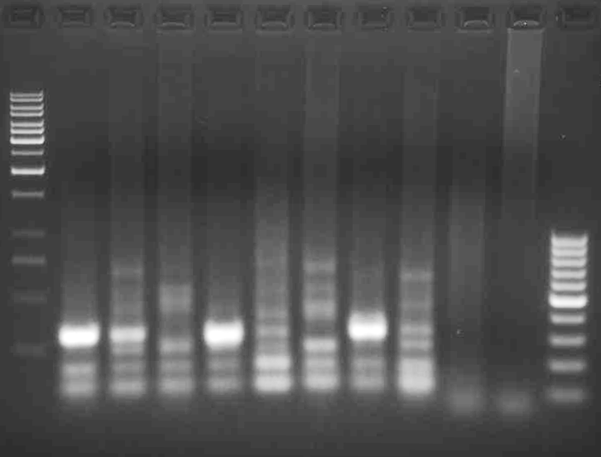
This is 10 separate reactions using the XG2 external PCR product along with different nested primers in order to determine which primer pair will work best for sequencing. You can see there is a single clearly visible dominant band in three of the lanes (1, 4, and 7). That quantity of product is more than sufficient for sequencing, which is the next step.
This nested PCR technique isn’t perfect, because it takes about 7 hours to run completely, and requires many reactions. That being said, I’m not convinced there’s a better alternative, and these disadvantages really don’t amount to much more than minor inconveniences. I am still working on optimizing this reaction for annealing temperature and other reaction conditions
In addition, I’ve tried using a different enzyme. For all my previous reactions, I had been using a high-fidelity polymerase called Q5, which costs roughly $2 per reaction. This enzyme, like many other high-fidelity polymerases, is really useful for amplifying very long products with very few errors, so it’s the first enzyme my lab turns to for PCR. For this application, I really don’t need anything that fancy. Instead, I’m using a more basic Taq polymerase that only costs ~$0.10 per reaction. This week, with all the nested reactions I was running, I needed as many as 60 PCRs per day, so reduced reagent costs are pretty substantial. The Taq master mix is also a nice time-saver, because it comes pre-mixed with a loading dye that allows for very easy gel electrophoresis.
Interestingly, although I expected this to only be a cost-saving measure, it drastically improved the specificity of my PCRs. Dr. Riggs and I think this is probably due to the Q5 enzyme + buffer being more tolerant of primer/template mismatches. Here’s the same nested PCR reactions, but using the Taq enzyme instead of the high-fidelity Q5.
 |
| SECURE THE BAND ALERT: it doesn't get much clearer than these! |
I’m planning on sending these out for sequencing on Monday, and hopefully I’ll be able to design and try my first qPCR by late next week!
Thanks for reading!
